Category: Blog

  • Sorrento Wedding Venues: Five Places I Have Photographed

    Sorrento Wedding Venues: Five Places I Have Photographed

    Sorrento sits on cliffs above the Gulf of Naples, about an hour from Naples airport and half an hour from Positano. Around it, the Sorrento Coast runs from Vico Equense to Massa Lubrense, with Capri just off the tip. Many couples choose it for the same reason: villas and gardens above the sea, Capri and Vesuvius in view, and a shorter drive from the airport than the Amalfi Coast.

    This is not a list copied from a directory. These are five Sorrento wedding venues where I have photographed real weddings, with my photographs and what I learned there: the view, the light, and where the day really happens.

    Villa Eliana, Sorrento: the terrace facing Capri

    Villa Eliana looks out at Capri from a terrace suspended over the sea. There is a garden, a pool on the terrace, and an open view that changes colour all evening.

    At Martina and Giuseppe’s wedding, the party moved from the garden to the terrace: spritz with friends, dinner at blue hour as the lights along the coast came on one by one, the cake by the pool, a last dance deep into the night.

    For a photographer it is a gift, and a temptation: it is easy to photograph the view and forget the people. Here the best photographs come at blue hour, when the sky and the coast lights balance and you can keep both the couple and Capri in the frame.

    Martina and Giuseppe walking on the terrace of Villa Eliana, Sorrento, with the pool and Capri behind them
    Villa Eliana, Sorrento

    See Martina and Giuseppe’s wedding at Villa Eliana

    Villa Zagara, Sorrento: a party in the olive grove

    At Villa Zagara the party happens under the olive trees. Long tables in the grove, lights in the branches, stone steps for the cake.

    Federica and Davide wanted no poses and no constraints, and the place made it easy. Spritz going around, a red megaphone passed from hand to hand, the cake on the stone steps among the sparks, then everyone dancing.

    The olive grove is at its best as evening falls, when the string lights take over from daylight. It is a venue for couples who want a long, relaxed table rather than a formal dinner.

    Wedding dinner under the olive trees at Villa Zagara, Sorrento, with string lights in the branches
    Villa Zagara, Sorrento

    See Federica and Davide’s wedding at Villa Zagara

    Capo Santa Fortunata, Sorrento: gardens, olive trees and a pool

    Capo Santa Fortunata is an estate in Sorrento: gardens, olive trees, a pool, and the bay in the distance. Chiara and Mattia’s wedding had 110 guests in the gardens, in a style both rustic and elegant.

    The space lets the day move: toasts on the lawn, the first dance, the cake beneath a stone arch, the sparks. At blue hour, with the lights on around the pool, the whole estate becomes one picture.

    That day every detail had something to say, down to a little red horn, the Neapolitan lucky charm, tied to each menu.

    The wedding party around the pool at Capo Santa Fortunata, Sorrento, at blue hour
    Capo Santa Fortunata, Sorrento

    See Chiara and Mattia’s wedding at Capo Santa Fortunata

    Relais Blu, Massa Lubrense: Capri so close you could touch it

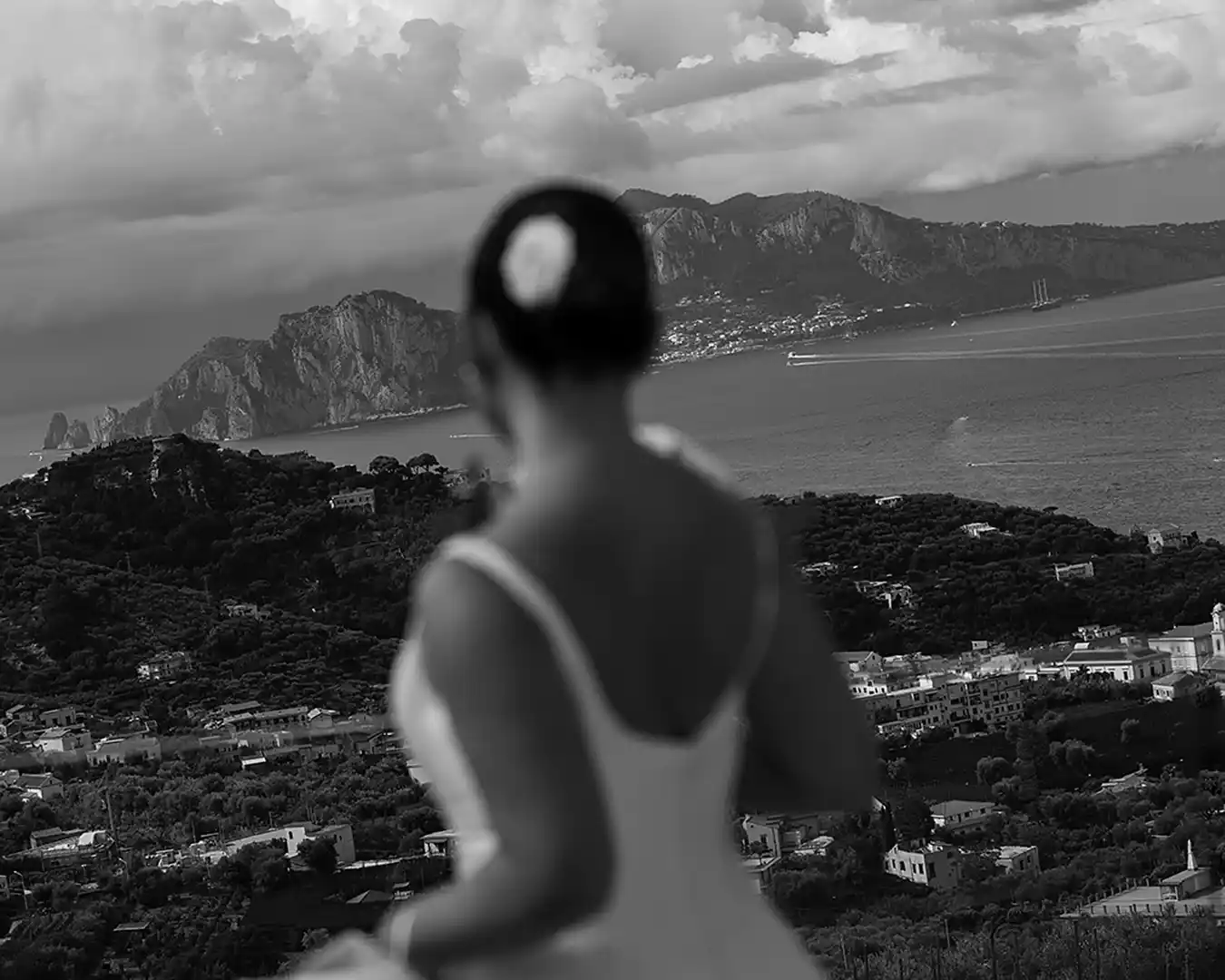
    Relais Blu stands above the sea in Massa Lubrense, with Capri so close you feel you could touch it. Coming back here is always a thrill.

    Fabiana got ready by a window open onto Capri. Later came the long table facing the island, sunset at the edge of the pool, dinner, toasts, and the cake among the sparks.

    Relais Blu faces Capri and the sunset. If you get married here, keep some time free before dinner: the light over the island is the best moment of the day for portraits, and it does not last long.

    The bride on the terrace of Relais Blu, Massa Lubrense, looking at Capri
    Relais Blu, Massa Lubrense

    See Fabiana and Luca’s wedding at Relais Blu

    Villa Angelina, Massa Lubrense: a historic house above the sea

    Villa Angelina is a historic house in Massa Lubrense. Capri ahead, pines above the sea, Vesuvius across the bay. Over the centuries many painters, and today many photographers, have tried to capture it as it really is. It changes every day, with the weather and with the people who live in it.

    That day it belonged to Rosaria and Pasquale: guests on the lawn, dinner under a white marquee, the saxophone, the first dance, the cake in the night.

    It is a place for couples who want a house with a history, not just a view.

    Guests on the lawn in front of Villa Angelina, Massa Lubrense
    Villa Angelina, Massa Lubrense

    See Rosaria and Pasquale’s wedding at Villa Angelina

    What I look at when couples choose a venue in Sorrento

    A few things matter more than they seem when you look at a venue from abroad:

    • Where the sun sets. The venues facing Capri get the sunset over the sea. It is worth building the timeline around it.
    • The distance from the church. On the map, distances on the Sorrento Coast look short. In summer the road is narrow and busy: plan the timing with your planner, so photographs never take time away from your guests.
    • Where you get ready. A room with good light and a window on the sea gives you photographs before the day has even started.
    • The evening. Most of these venues are at their best after sunset. Ask how the garden or terrace is lit at night.

    If you are choosing between these places, or have another venue in mind on the Sorrento Coast, I am happy to tell you what I know about it. Here is how I work as a wedding photographer in Sorrento.

    Sorrento wedding venues: questions and answers

    How far is Sorrento from Naples airport?

    About an hour by car. Positano is about half an hour from Sorrento.

    Are these venues on the Amalfi Coast?

    No, they are on the Sorrento Coast, the other side of the same peninsula: Sorrento, Massa Lubrense and the villages around them. The Amalfi Coast is close by.

    Do you photograph weddings at other venues in Sorrento?

    Yes. These are five venues where I have published a full wedding; I work all along the Sorrento Coast.

    Are there travel costs for a wedding in Sorrento?

    No. Sorrento is my area, on the same gulf as Naples.

  • Film Wedding Photography in Italy: Black and White, Printed by Hand

    Film Wedding Photography in Italy: Black and White, Printed by Hand

    I learned photography on film. So when I offer film wedding photography today, I am not following a trend: I am going back to where my work began.

    If you are getting married in Italy, I can photograph part of your day on black and white film, alongside the full digital coverage. After the wedding I develop the rolls and print a small selection by hand, in my own darkroom. You receive real photographs: objects you can hold, frame and keep.

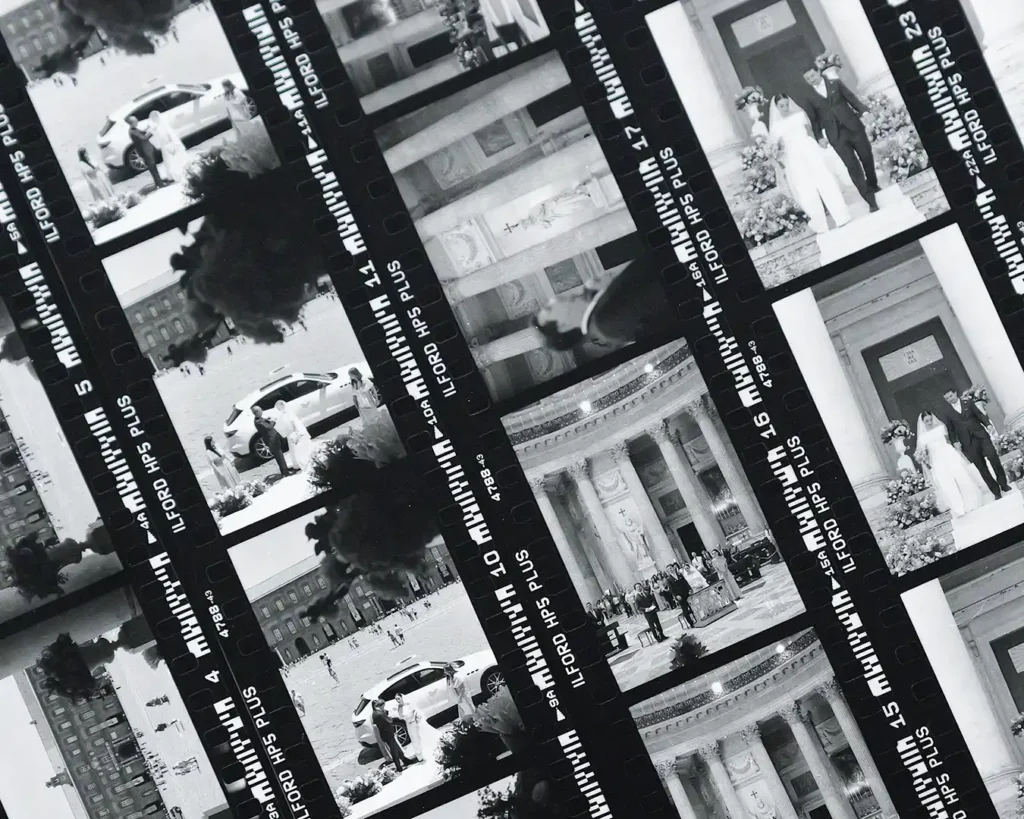
    A black and white contact sheet from a wedding, shot on Ilford HP5 Plus 35mm film
    Contact sheet from a wedding on Ilford HP5 Plus

    How film fits into your wedding day

    Film does not replace digital coverage. It sits next to it.

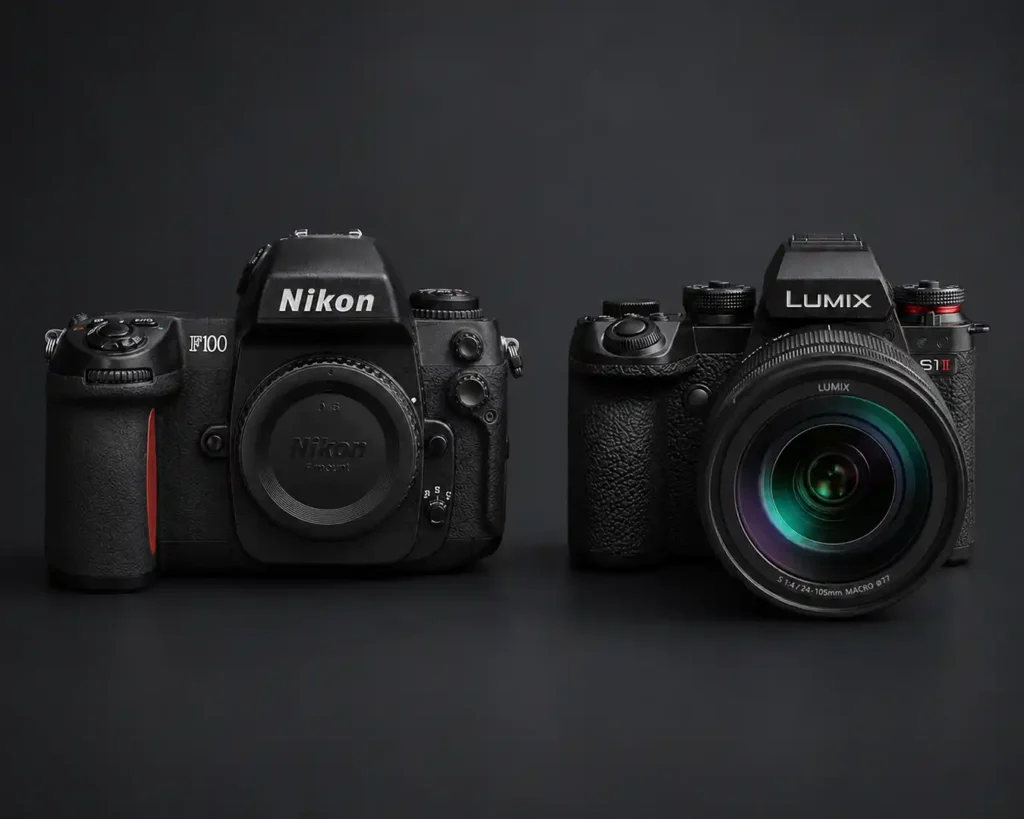
    On the day I carry two cameras, one digital and one film. For 35mm film I use a Nikon F100: fast, precise and reliable enough for a day that never stands still. On request, I also shoot 6×6 medium format, with a Hasselblad 500 C/M.

    When I shoot film, I prefer to work with a second photographer, so that every important moment is also covered in digital. It is not a lack of trust in film. A wedding is a responsibility, and your coverage has to be complete and safe.

    You do not need to plan anything differently: the film frames are taken during the day, in the same moments I am already photographing.

    A Nikon F100 film camera next to a Lumix S1II digital camera
    Nikon F100 and Lumix S1II: film and digital, side by side

    What you receive

    After the wedding I develop the rolls and choose the frames to print. The final selection is usually about twelve black and white photographs, printed by hand in my darkroom, generally 12 × 18 cm (about 5 × 7 inches).

    Twelve photographs are not many. That is the point: a few images, chosen and worked on one by one, made to last. Together with the prints, you receive the contact sheets in digital form, so you can see every frame on your rolls.

    Printing twelve fine art photographs takes at least six hours in the darkroom, even when you work fast and know the process well. What you receive is not only a print. It is time, skill, attention and interpretation.

    The film service costs €300, in addition to your wedding photography. If you live abroad, I ship the prints to you, and the shipping is added to the price.

    Why film, today

    Cameras have never been so perfect. Lenses get sharper every year, files hold an enormous amount of detail, and everything can be corrected. After a while, this constant search for perfection becomes tiring. Digital records every detail, even the ones an image does not really need: skin, fabric, light and tones can all become too precise, too controlled.

    Film brings a different relationship with the photograph. It does not mean leaving everything to chance, or printing a negative “as it is”: with film, too, you correct and interpret. But the starting point is a physical document, tied to one precise moment that will not come back.

    At a time when artificial intelligence produces more and more perfect images, I feel the need for something with a more concrete presence. Film is not just an aesthetic. It is process, matter, limits and waiting.

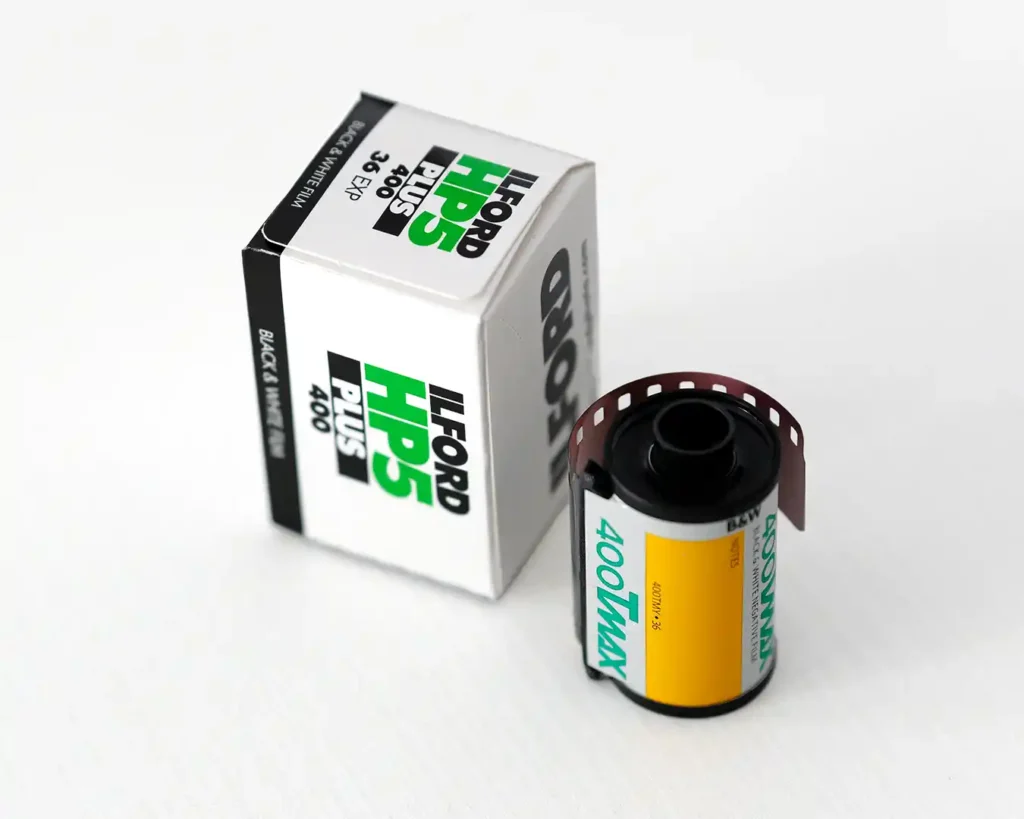
    A box of Ilford HP5 Plus 400 and a roll of Kodak T-MAX 400 black and white film
    Ilford HP5 Plus 400 and Kodak T-MAX 400

    From negative to print, in my darkroom

    After the wedding comes the slow part. I set up my darkroom when I need it, in one of the rooms of my studio, and work in sessions of two or three hours.

    First, the negatives are developed in the tank, with precise times, temperatures and agitation: every choice changes the final negative. Once they are dry, I make a contact sheet, which shows the whole roll on paper. It is one of the most important moments, because it lets me see the sequence and understand which frames really deserve to be printed.

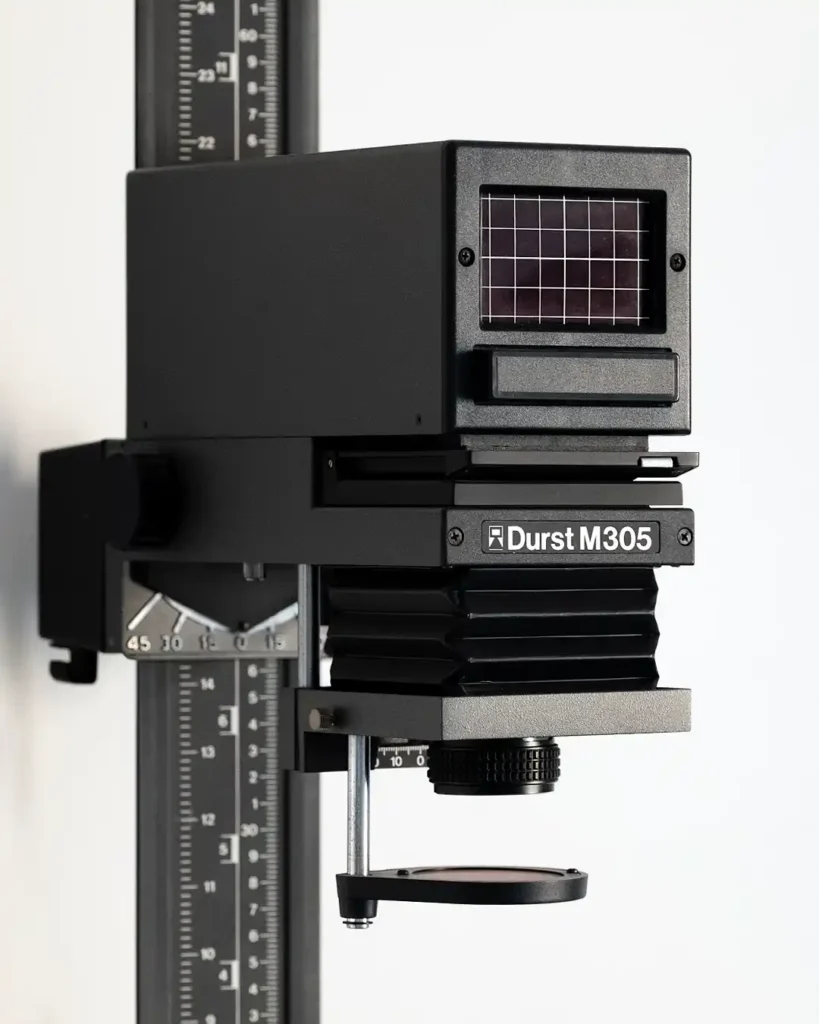
    Then each chosen photograph is printed under the enlarger: a Durst M305 for 35mm and, next to it, a Durst M805 for medium format. Every image needs its own exposure, its own contrast, sometimes some work on parts of the frame. No two prints are the same, because every negative has its own structure.

    The Durst M305 enlarger in Elia Vaccaro’s darkroom
    Durst M305 enlarger

    This is what fine art printing meant, long before the words were used everywhere: starting from a negative, interpreting it frame by frame and working on the paper until the image is complete.

    Exchanging ideas with Giulio Limongelli, one of the most skilled printers in Italy, helped me refine my technique and, above all, simplify my approach. The darkroom needs technique, but it also needs common sense.

    Two strips of developed 35mm black and white negatives
    Developed negatives, Ilford HP5 Plus 400

    Where it started

    I started photographing in 2001 and 2002 with an Olympus OM-1 from 1972, a fully manual camera given to me by my uncle. Its slowness taught me the basics: observe, focus, choose the moment, wait.

    I spent my first years as an assistant next to a wedding photographer who still worked with a Zenza Bronica 6×6. In those years I also set up my first darkroom for black and white printing.

    Then came digital, and for years wedding photography was almost entirely digital, mine included. But the darkroom never really went away. In 2015 I started offering some couples two or three rolls of black and white film alongside the digital coverage, developed and printed by hand. Couples were very interested; then the seasons and the deadlines left little room to talk about it. Today I have decided that it deserves to come back.

    Print your photographs

    Today many images exist only as files: in a phone, on a hard drive, in a cloud, often with nowhere to go. Who knows where they will be in twenty or thirty years, or whether anyone will still be able to open them.

    This is why I always suggest printing. Even just ten good photographs from every important moment. A small print costs very little compared to the memory it holds. A printed photograph stays.

    If you shoot film yourself

    This article is also for anyone who has bought an old 35mm camera, shot a few rolls and wants to know what happens next. Printing in a darkroom may look difficult, but it is within reach. You need method, order and patience, not fear. Start with a simple camera, a roll of black and white film, a developing tank and a few essentials.

    Do not confuse complexity with quality. Quality comes from knowing what you are doing, why you are doing it, and what result you want.

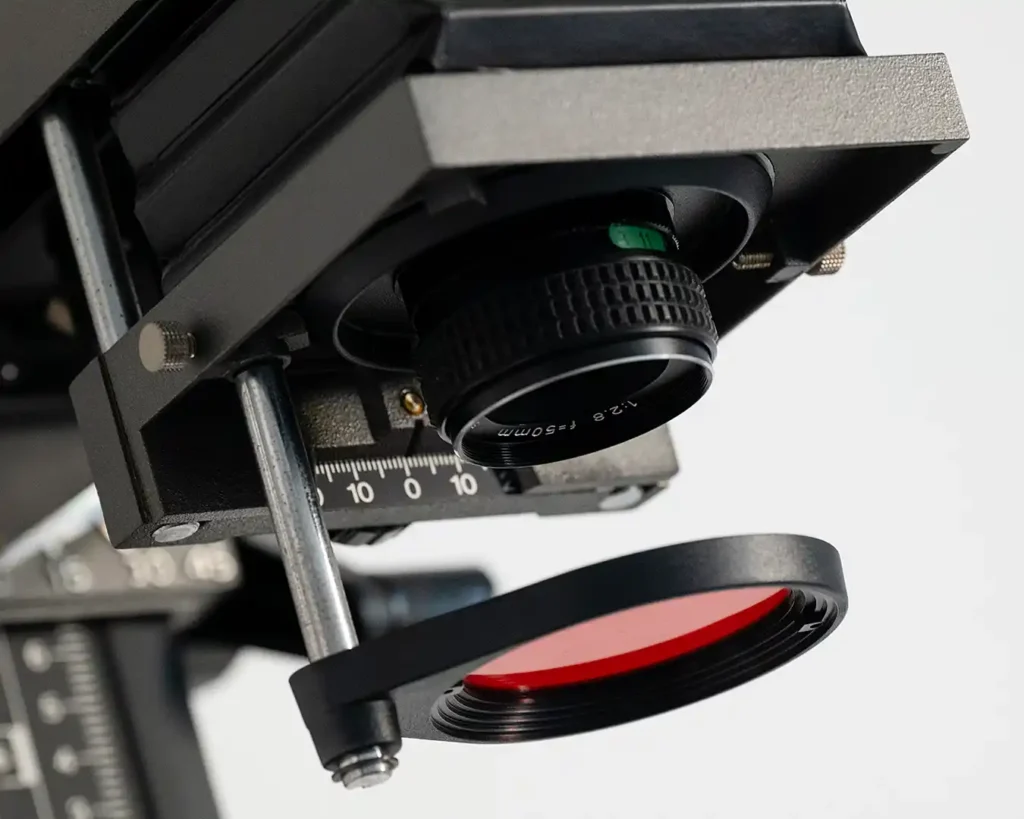
    A Schneider 50mm f/2.8 enlarging lens with the red safety filter, under the Durst enlarger
    Schneider 50mm f/2.8 enlarging lens

    Film, weddings and memory

    At a wedding, film is not meant to tell the whole story. It creates a small set of images with a different weight: more physical, slower, closer to the idea of memory. In a time when we produce thousands of files, a few real prints can be an almost necessary gesture.

    If you would like film at your wedding in Italy, mention it when you write to me: we will talk about it together.

    Film wedding photography: questions and answers

    Can we have film photographs at our wedding in Italy?

    Yes. Film sits alongside the digital coverage: during the day I shoot black and white film in 35mm and, on request, in 6×6 medium format with a Hasselblad 500 C/M. After the wedding I develop the rolls and print a selection by hand in my darkroom.

    Does film replace the digital coverage?

    No. Digital covers the whole day, safely and completely; film adds a small, slower selection of hand-printed photographs. When I shoot film I prefer to work with a second photographer, so every important moment is also in digital.

    How many film photographs will we receive?

    Usually about twelve black and white prints, 12 × 18 cm (about 5 × 7 inches), printed by hand in my darkroom, together with the contact sheets in digital form. A few photographs, chosen and worked on one by one.

    How much does film cost?

    The film service costs €300, in addition to your wedding photography.

    We live abroad: how do we receive the prints?

    I ship them to you. The shipping is added to the price.

    How long does it take to print them?

    Twelve fine art prints take at least six hours in the darkroom, after the negatives have been developed and the contact sheets made.

    Why black and white film?

    Because film gives a different relationship with the image: grain, matter, waiting and presence, instead of absolute perfection. At a wedding this means more essential, intimate photographs, close to the idea of memory.